The second time through the Kiel Canal, it gets no more exciting. Yes, it’s the busiest canal in the world. And yes, the big ships sliding past just a few metres away are impressive. But it’s also, when it comes down to it, simply nine uneventful hours of motoring to get from the North Sea to the Baltic, or the other way round. What’s different today from last time: a good many tall ships coming the other way.
At the lock in Kiel-Holtenau they’re friendlier again than in Brunsbüttel, and they put the three of us waiting pleasure crafts through in a lock of our own, without the commercial shipping.
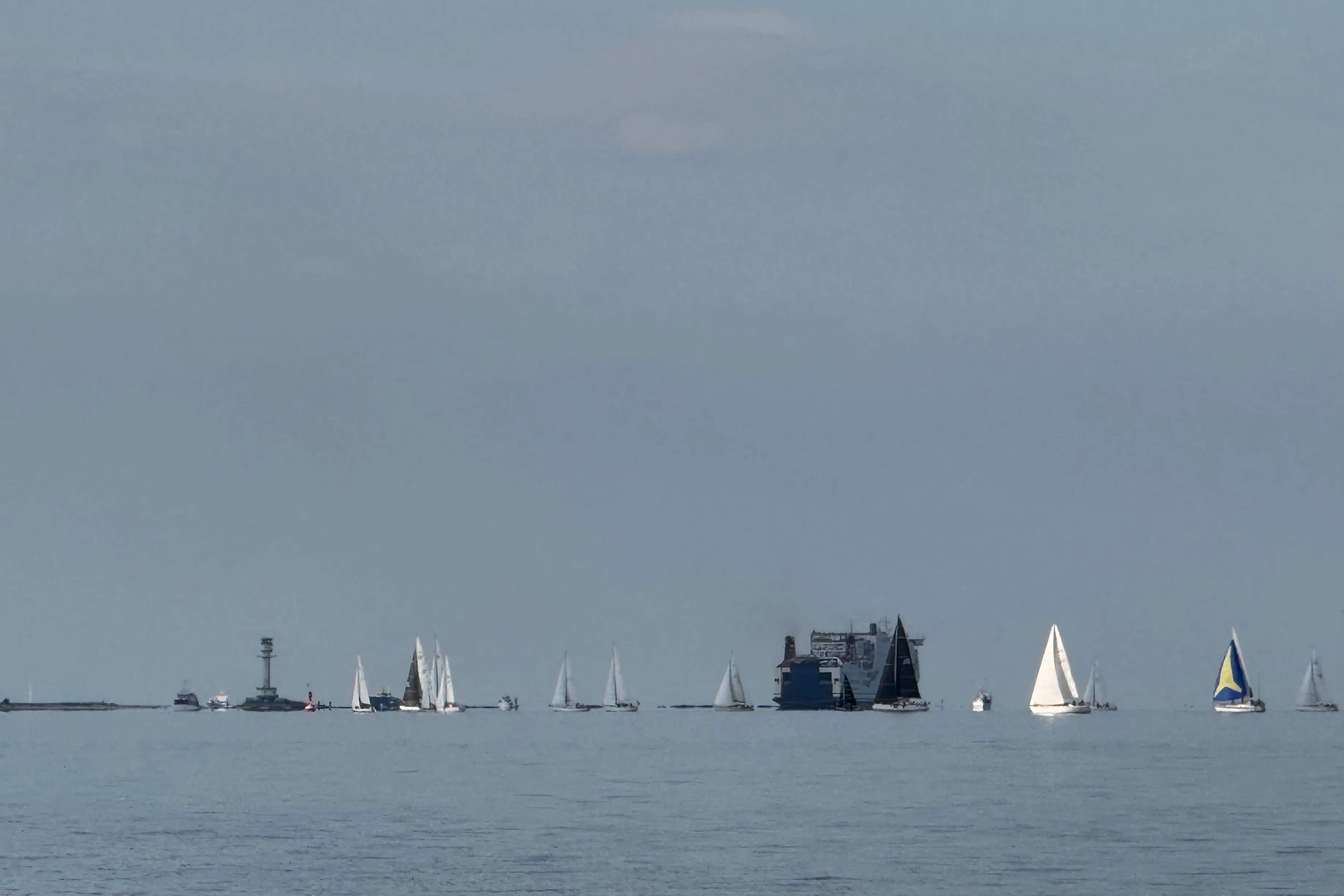
In Kiel, out on the Kieler Förde, the scene presents itself as it does every time: between the big ferries to Norway or Sweden and the cruise ships, it’s thick with sailing boats. At the edges of the fjord, children in their Optimists. In the middle of it all, some boats out for a gentle sail, others in regatta mode – everyone, it seems, is sailing on a summer’s Monday afternoon. Two or three hours’ sailing after work, I imagine.
Kiel. If there’s a home of yachting in Germany, it’s here. I’ve no idea what it’s like to grow up in Kiel and not sail. Probably like growing up in the Valais and not taking to the mountains. What it must be like to grow up here and sail as a child, to head out on afternoons as a teenager, to leave the fjord for the first time, out onto the Baltic, to Denmark, Sweden, the first time through the Kiel Canal to the North Sea …
Kiel is probably the German counterpart to Cowes on the Isle of Wight. The Kieler Yacht-Club (formerly the Imperial Yacht Club) the counterpart to the Royal Yacht Squadron in Cowes. Kiel Week the counterpart to Cowes Week. I was in Cowes countless times in 2018, and it feels similar here. Here a cliché meets reality. Especially in regions where sailing seems remote, the cliché holds that sailing is, above all, a matter of money and status. Yacht clubs that carry royalty in their very names seem to bear it out. But on the ground, the reality is a different one. I’ve seen it most starkly so far in Brittany: seemingly worn down boats on which fierce sailors set off on demanding passages. (Then again, how could it be otherwise in Brittany? In Europe, at least, there’s probably no more demanding region to sail.)
And here in Kiel: as I search the harbour basins in Düsternbrook for a free berth — into a basin, turn around, search the next – it strikes me at once: ordinary, honest boats. Some bigger, some smaller. On the third attempt I’ve found a free spot, and approach the berth. An older gentleman comes to take my lines, and laughs briefly when he sees I’ve no one to send forward to the bow to hand them to him. By the time I’ve finished aft – Koraki still motoring gently against the stern lines, sitting steady in the berth – and come forward to the bow to pass him the lines, we fall into a bit of a natter. The usual. Where I’ve come from. — Ah, from the Netherlands. That England didn’t come off this year. Well, England won’t run away from you. Just do it next year. … A nice chat. A chat that feels like the talk in a mountain hut. Familiar. Known. Home.
As it turns out a little later, Kiel Week ran until yesterday. So that explains all the tall ships on the Kiel Canal. Lucky, then, that I only came through the canal today. Yesterday I’d not have found a berth here in Kiel. The outlook for the next few days: on Wednesday Richard arrives from England. From Thursday on — and Friday and Saturday above all — a proper storm is forecast here for now.