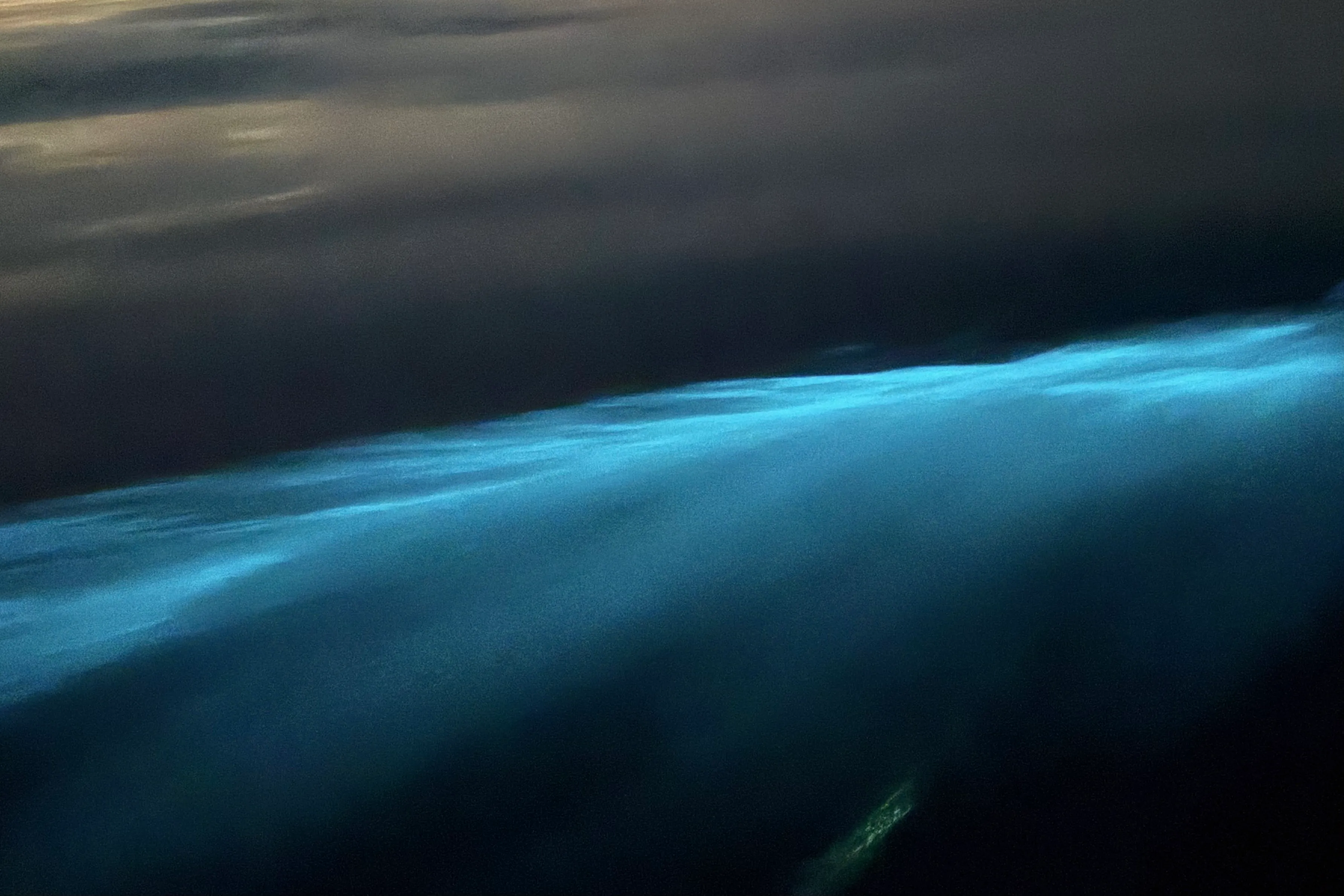
At night, out at sea, the hours between sunset and sunrise – I love them. A calm settles in me. Perception pared down to the movement of the boat on the sea, the few buoy lights on the horizon to steer by, and the night sky, moon and stars. What today added was the glow of the sea. Tiny organisms, mostly algae, that begin to glow when the current shifts. Bioluminescence. The bow waves light up. It happens more often than you might think. I hadn’t seen it in four years all the same. It comes and goes, over and over, and for hours Koraki’s bow waves glow.
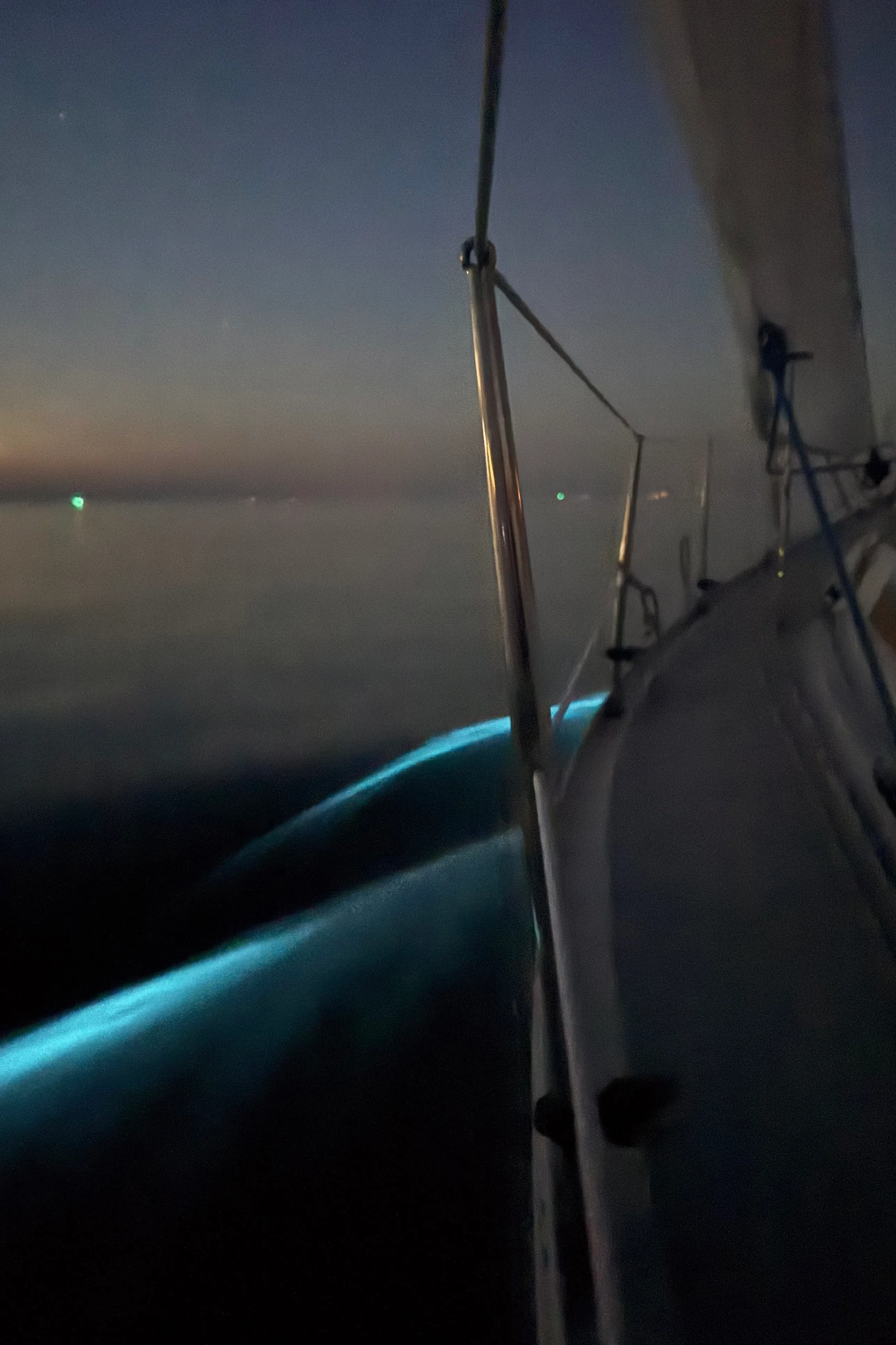
I’m lost in thought. The journey. Once again the dream surfaces, still there even though it isn’t happening this year. Once around England. And then back to this morning, too: just after four we had to get up, because the two boats we’re rafted alongside want to leave at five. Break up the raft, cast off, wait in the basin, wait until the other two boats have gone, and tie up again. And back to bed for another quick nap. By nine I’m awake, and up. Just after eleven we cast off. Sails up in the harbour and out onto the Ems fairway. The tide with us. As forecast, the wind is light, but enough to sail for now. By early afternoon the wind dies away, and we put the engine on. We need to be in the Elbe by eight in the morning at the latest to still have the tide with us. While the engine runs, Neuwerk passes us, a large vessel of the German coast guard. I worry that Martin is in for another day under engine, when he’s here, after all, to sail. A little later the radio crackles into life.
– Neuwerk, Neuwerk, this is sailing vessel Red Zeal. Over.
– Red Zeal this is Neuwerk. Over.
– Neuwerk, this is Red Zeal, change to channel zero six, please. Over.
I can’t help smiling, and I want to listen in – even though eavesdropping isn’t really the done thing – so I switch to channel 06 as well.
– Neuwerk, this is sailing vessel Red Zeal.
– Red Zeal, this is Neuwerk, over.
– Neuwerk, can you see me? I’m on your starboard side.
A short pause
– Red Zeal, I can see you on my starboard side. Over.
– Neuwerk, what are your intentions?
– Red Zeal I will change my course and will pass port to port.
– Neuwerk. Thank you. Have a nice watch.
Martin and I sit in the cockpit and laugh. There’s the little Belgian yacht calling up the big German coast guard vessel – and pointing out to the coast guard, of all people, that it’s the one obliged to give way. Good call.
A good hour later there’s enough wind again. Engine off. Trim the sails to wring the most out of what little wind there is. Four knots through the water. That should be enough to reach the Elbe in time, on the right tide. The next hours bear out the saying that two sailing boats on the same course are always a race. Red Zeal had already come with us from Vlieland to Borkum. Today they cast off half an hour ahead of us. I’d called across to the skipper. Heading for Cuxhaven? – No, for Brunsbüttel. – Oh, so we’ll see each other again tomorrow. From that moment it was clear that I’d naturally try to get there ahead of them. Not grimly, not at any price, but a little challenge never hurts. Red Zeal went round the so-called Borkum Riff; we cut the corner (the Borkum Riff – it sounds wilder than it is. It’s a sandbank reaching far out to sea, but at high water there’s more than enough over it to sail through, even with a draught of 1.80 metres). Since then we’ve been a little ahead. So when there’s enough wind to sail again, my motivation to stay under sail is all the greater. (Under engine it’s simply not a race.) Not half an hour passes without my trimming again, trying to coax out another half a knot. And so the hours go by under the burning sun of this much-discussed heatwave. The gap to Red Zeal grows, slowly but steadily.
It’s good to have Martin along out here. Our rhythm at sea is much like on our hike-and-fly trips. A stretch together, deep in conversation. Then each to ourselves again. Lost in thought, perhaps, or reading below. Then together again for a stretch. As the sun sits low, Martin goes below and cooks us a pasta caprese.
While we eat in the cockpit, the sun goes down. A good moment for The Alan Parsons Project’s Eye in the Sky. By the time the sun’s gone, we’re nearing Jade and Weser. We have to give way to big ships three times. Then it turns quiet and dark, and the sea begins to glow.
After all these many nights at sea, in the most varied conditions, I still find it hard to put my finger on what it is about being out on the sea at night. Martin feels it too. Perhaps it’s this sense of nothing all around. On a night like tonight – fairly warm, peaceful – it doesn’t grow dull, tired as I am, simply to look at the sea, the water, into the darkness, into this nothing, while Koraki just keeps moving on through the water.
We’re getting close to the Elbe. When people think of the Elbe, they usually picture a river. In the mind that river may be big, perhaps very big. But that picture doesn’t match the vast Wadden Sea, the breadth of the Elbe mouth stretching away beyond the horizon, into which you sail when you want to enter the Elbe. Here it starts to grow light, the sun lifts over the horizon, and between the sandbanks of the Wadden Sea we see grey seals; porpoises surface briefly for air. Gulls fly in the sky, against the rising sun. What a sunrise on the Elbe.
It’ll be midday before we reach the lock at Brunsbüttel. A good way short of Cuxhaven the wind drops away and we start the engine. By the time we’re waiting over an hour off the lock at Brunsbüttel, the tiredness really starts to show. Twenty-four hours at sea without sleep leave their mark. It’s no better with no wind and 37 degrees.
An alarm on the radio. Once more the mind is snapped back to full attention. I go below, and then it begins. A tense voice:
– Mayday Relay, Mayday Relay, Mayday Relay. This is Lyngby Radio. Mayday.
It’s the fourth time in my life that I’ve received a Mayday over VHF. This time, too, it’s a moment when, from one second to the next, I’m completely awake, completely present. The proverbial “blood running cold in the veins.” And even now, simply recounting it, I have to swallow hard. Hand to pen, paper.
– Mayday. Sailing Vessel Allegro, in position five zero degrees … – the coordinates spelled out by Lyngby Radio, the Danish coast radio station. Everyone, truly everyone, receiving this right now hurries to the radio and takes down the coordinates, to check them against their own.
– Man overboard.
Phew. At this point I know we can’t help. It’s far too far away. I’m even surprised I could receive Lyngby Radio at all.
– All vessels close to this position are requested to … – the centuries-old tradition, the law of the sea, no matter whether commercial shipping or leisure sailor. Everyone in the vicinity is obliged to render assistance. And if it’s in the remote South Pacific that a sailing boat is wrecked … the 400-metre container ship will change course, will turn around, will even sail for days to reach the scene, if that’s what it takes to give help.
Then the radio falls silent – simply too far away. Perhaps this is exactly what the sea is: one moment this sense of nothing all around, alone in the dark – and yet in the same instant bound to every boat out there, under obligation.
Soon after, the lock opens. We tie up in the inner harbour of Brunsbüttel. Martin will take the train back to Munich first thing tomorrow. For me, it’s on to Kiel the day after.