About ten years ago, a video first brought Vlieland to my attention. Ever since, the name, the island, has stayed in my head — and now, at last, here I am. I’m glad to be here at last; a favourite place. The search for favourite places. Perhaps that’s a fitting description of my travelling. Jean, my old flatmate in Montpellier, showed me how it’s done: guidebooks, no need for them. More than that: I don’t want them. A chart, an idea, and then simply explore for yourself, find your own places. Deliberately doing without the canonised experience of the sights that guidebooks promise. Set against that is the uncertainty of experience. Let’s see what comes. Perhaps nothing does. And then the lasting experience happens after all. My two favourite islands, Fårö off Gotland (not the Faroes) and Anholt in the Kattegat, came my way just like that. Neither a hidden gem in the literal sense. Nor, though, the kind of hidden gem trumpeted as a “must see” in books with print runs in the millions. Both favourite places for me – for the nature I found there and the people I met there. And so now: Vlieland.
In Harlingen the departure was dictated by the tides. The leg over here was lovely and low-key. As ever in the Wadden Sea: water as far as the eye can see. Yet only fairly narrow channels are deep enough to sail. From Harlingen northwards the current runs strongly with me; after rounding the great shoal off Vlieland to the north, on the approach to the island, the current sets almost three knots against me. To the eye it looks as though the buoys marking the channel are shoving through the water at over three knots, while you yourself merely creep past them at two and a half. It’s only a short stretch against the current. By the harbour the current then runs across the entrance. All quite normal in tidal waters, but as in Cuxhaven the rule here, too, is not to steer straight for the entrance – the current would otherwise sweep you onto the land beside the entrance rather than into it. Lay off a good thirty degrees to actually make the entrance. Inside the entrance the current is gone at once; the harbourmaster tells me where to find a berth, and the mooring is about as unspectacular as it gets.
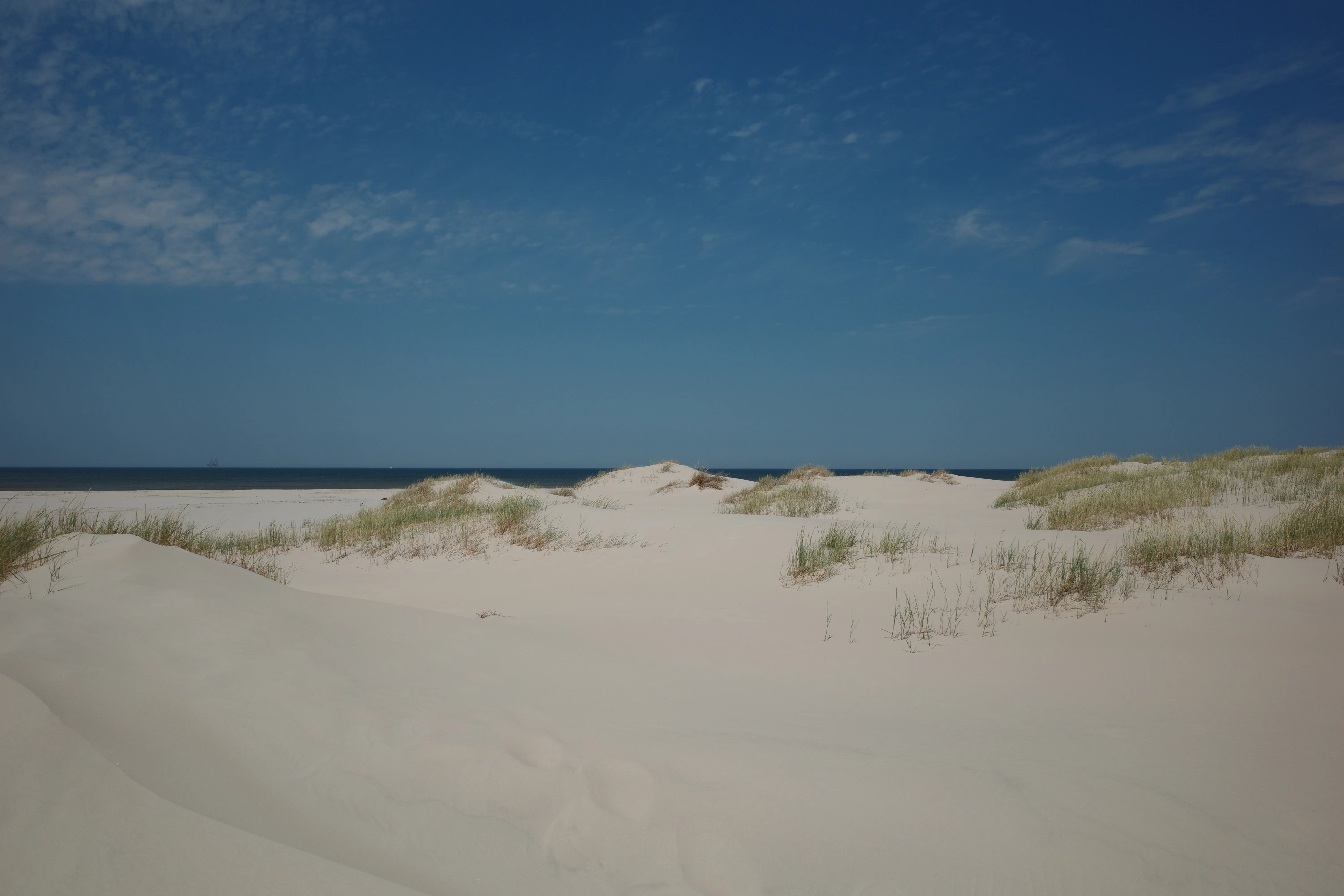
In the marina it’s almost all Dutch boats. A few German ones, the odd Belgian and British boat, even one from Norway, mixed in among them. The marina is large; the island lives on tourism. But the moment you hop on a bike and head for the beach, you’re practically alone. The beach … as, I think, on all the Frisian islands, simply enormous, beautiful, fine sand, dunes, and south of the beach a vast bird-breeding ground. On the beach I do indeed see more bird colonies than people.
It seems to me that everyone who comes here does only three things: cycle about the island, lie somewhere on the beach in the wind – sleep, read, dream, listen to the sea and the birds – or walk the beach for hours. Not the unspoilt wildness of Fårö, not the remoteness of Anholt with its 134 inhabitants. But sun, wind, sea and sand, dunes, birds … birds soaring on the wind along the dunes … nothing more is needed. I lie on the beach, the wind blowing sand into my hair, I read on in Capitalism: A Global History, doze off, wake, look out to sea … a favourite place.