From Lauwersoog to Harlingen the way runs through the narrow canals of Friesland, every so often with only twenty centimetres of water under the keel, and through countless bascule bridges. It’s at the bridges that one of the challenges of single-handed sailing becomes tangible.
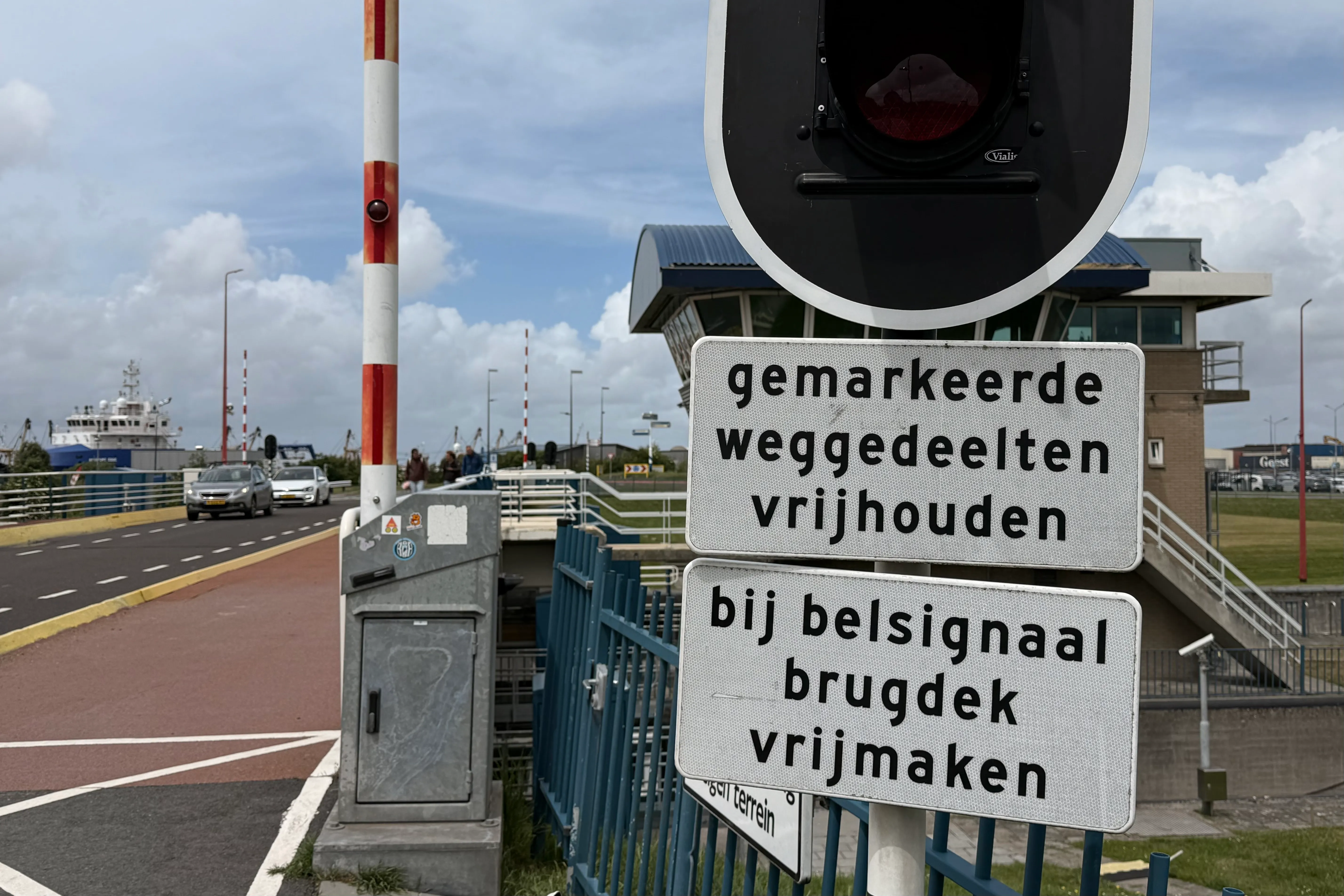
Before each bridge there’s a waiting pontoon. You tie up briefly, step ashore, press a button, and a few minutes later the bridge’s signal light goes from red to green-and-red, the barriers come down and the bridge swings open. Time to cast off; the light turns green, and you do best to go briskly through the open bridge, so that cyclists and drivers don’t have to wait too long.
With three of you aboard: harmless enough. One at the bow, one at the stern, one at the helm. The boat comes to a stop, two lines are quickly made fast fore and aft. On my own, though, I can’t be at the bow and the stern at once. The problem: the moment the boat has stopped at the pontoon, the wind blows the bow off. Do nothing, and within seconds you’d be lying across the pontoon. So you work out techniques that hold the boat steady alongside with lines handled from the cockpit alone. Mine: bring the boat to a stop, throw a line that runs over the midships cleat from the cockpit over the bollard on the pontoon. Motor slowly ahead against that line, and set the rudder so that the thrust of the propeller and the midships line together hold the boat parallel to the pontoon. Then throw a stern line over the same bollard, so that later, on leaving, I can give the boat a brief nudge off the pontoon. Press the button for the bridge …
For non-sailors this may not mean much. The gist: it demands a seamless plan and full concentration, and the moment there’s a bit more wind, it’s stressful every time. Even when it runs exactly as in the textbook in my head, there’s stress in it every time. Simply because you can’t be fore and aft at once. Simply because you’re one hand short.
It’s perhaps twenty bridges to Leeuwarden. You get the practice, but the tension stays.
Markus and I stay the night in Leeuwarden. Here, once again, my fondness for the Netherlands is borne out. As in Denmark, I keep thinking: cool country, cool people. It’s hard to put a finger on it. With the houses and streets, everything seems a touch smaller to me, but with more love for detail. For someone like me, who cycles in Munich 365 days a year, it’s a joy to see that – living up to the reputation – here simply everyone is out on a bike. And on the street, differences in wealth are less visible than I’m used to from Munich. I feel at ease here.
Part of it, probably: at least the written language really does feel as though German were only a sound shift away. And it reminds me of a time when I read Jostein Gaarder’s De wereld van Sofie in Dutch, in Montpellier.
In the evening Markus and I go out to eat in Leeuwarden. The next day his parents come to visit. I carry on to Harlingen. We’ll meet again there. – Through another dozen bridges, I tie up at midday in a lovely little harbour in Harlingen. A lovely little town. Canals, old harbours, and it’s time for a proper helping of poffertjes. Something that keeps happening to me with young Dutch people, in a café, say: I speak to them in English, they answer in Dutch. From the context I understand enough, answer in English, and they, again, in Dutch. I wonder whether Dutch and English are so second-nature to them as languages that they perhaps don’t even notice I spoke English?
On Friday the next visitor arrives. Jan, my old companion, comes from Cologne for a weekend’s sailing.